- 签证留学 |
- 笔译 |
- 口译
- 求职 |
- 日/韩语 |
- 德语

André a frappé Bernard avec un marteau
or Polish
Andrzej uderzyl Bogusia mlotkiem
or Hindi/Urdu
Aziz ne Bikram ko hãtore se mära
or Japanese
At ushi kun wa Benjiroo kun o tuchi de uchimasita
or Latin
Antonius Brutum malleo tetigit
or Cantonese
Akahu juhng chuih daai Bahba
or Arabic
dharaba Ahmadu Bilala bilmitraqathi
What is crucial here is the propositional structure, not the syntactic or the lexical.
Although the syntactic and lexical variations between the languages are strikingly large, it is only of secondary importance that the syntactic structures (choices from the MOOD system) are:
S P O A in English, French and Polish
S O A P in Hindi/Urdu, Japanese and Latin
S A P O in Cantonese
P S O A in Arabic
The significance of this for the translator is fundamental. The fact that the proposition is universal (not tied to a specific language but underlying all languages) gives it its central position in communication and provides us with a major clue in our attempts at making sense of the process of translation. As we saw in the presentation of the model
of the process, the reader's initial task (and the translator's) is to decompose the language-specific clauses of the written text into their universal propositional content. Until this is done (and additional information added to it to create the semantic representation of the clause), neither comprehension nor (necessarily) translation is possible.
In short, we are suggesting that any utterance is a token of a sentence type, which is itself a token of a proposition type.
In other words, in the terminology we used earlier in the discussion of meaning postulates, proposition includes sentence and utterance, and sentence includes utterance, i.e. there is a relationship of hyponymy between the superordinate proposition and the subordinate sentence and utterance:
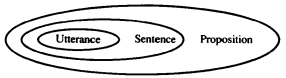
Our consideration of meaning has now reached the point where we need to move beyond the description of the formal aspects of the code and appeal outside the linguistic structure in cases of ambiguity, entailment, implicature and presupposition. This will require us to introduce three levels of location for any communicative stretch of language, i.e. the 'setting' of the interaction with its communicative functions realized by the linguistic forms of the code.
责任编辑:admin