- 签证留学 |
- 笔译 |
- 口译
- 求职 |
- 日/韩语 |
- 德语

Use a relatively low-pitched tuning fork of 128 Hz. Tap it on the heel of your hand and place it firmly over a distal interphalangeal joint of the patient's finger, then over the interphalangeal joint of the big toe (Fig. 1). Ask what the patient feels. If you are not sure whether the patient is feeling pressure or vibration, ask the patient to tell you when the vibration stops. Then touch the tuning fork to stop it from vibrating and confirm this change with the patient. If vibration sense is impaired, proceed to more proximal bony prominences (e.g., wrist, elbow; medial malleolus, shin, patella, anterior superior iliac spine, spinous processes, and clavicles).
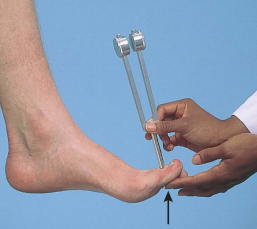
FIGURE 1. Test vibration sense.
责任编辑:admin