- 签证留学 |
- 笔译 |
- 口译
- 求职 |
- 日/韩语 |
- 德语

Diabetes causes several types of peripheral neuropathy. Maintaining optimal glycemic control can prevent or delay the onset of neuropathy, particularly from type I diabetes.
■ Distal symmetric sensorimotor polyneuropathy. This is the most common type of diabetic neuropathy. It is slowly progressive, often asymptomatic, and a risk factor for ulcerations, arthropathy, and amputation. Symptomatic patients report burning electrical pain in the lower extremities, usually at night.
■ Autonomic dysfunction, mononeuropathies, and polyradiculopathies, including diabetic amyotrophy, which initially causes unilateral thigh pain and proximal lower extremity weakness.
Diabetic patients should have their feet examined regularly for neuropathy, including testing pinprick sensation, ankle reflexes, vibration perception (with a 128-Hz tuning fork) and plantar light touch sensation (with a Semmes-Weinstein mono-filament), as well as checking for skin breakdown, poor circulation, and musculoskeletal abnormalities. The monofilament test involves pressing the perpendicular monofilament against the skin at the great toe and metatarsals until it bends (Fig. 1), or against the dorsal arch if without calluses; the test is positive if the patient cannot feel the monofilament.
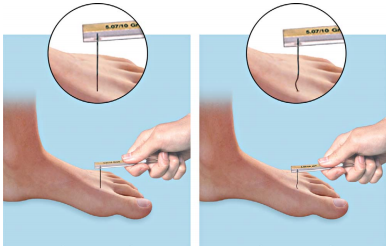
FIGURE 1. Monofilament test.