Palpate the radial pulse with the pads of your fingers on the flexor surface of the lateral wrist (Fig. 1). Partially flexing the patient's wrist may help you feel this pulse. Compare the pulses in both arms.

FIGURE 1. Palpate the radial pulse.
If you suspect arterial insufficiency, palpate the brachial pulse. Flex the patient's elbow slightly, and palpate the artery just medial to the biceps tendon at the antecubital crease (Fig. 2). The brachial pulse can also be palpated higher in the arm in the groove between the biceps and triceps muscles.
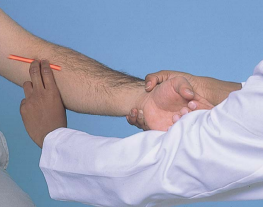
FIGURE 2. Palpate the brachial pulse.
Palpate one or more epitrochlear nodes. With the patient's elbow flexed to about 90º and the forearm supported by your hand, reach around behind the arm and feel in the groove between the biceps and triceps muscles, about 3 cm above the medial epicondyle (Fig. 3). If a node is present, note its size, consistency, and tenderness.
Epitrochlear nodes are difficult to identify in most healthy people.

FIGURE 3. Palpate the epitrochlear nodes.
责任编辑:admin
上一篇:没有了
下一篇:医学文章阅读——Screening for Abdominal Aortic Aneurysm

微信公众号搜索“译员”关注我们,每天为您推送翻译理论和技巧,外语学习及翻译招聘信息。