A variety of patterns, in particular NSIP and OP, are associated with drug-induced lung disease. Of these, the NSIP pattern is the most common. Drugs reported to cause an NSIP-type pattern include amiodarone, busulfan, carmustine, methotrexate, phenytoin and simvastatin. Descriptions of HRCT findings are available for a limited number of agents, but demonstrate the same range of abnormalities described in patients with the idiopathic form of NSIP (Fig. 1). With disease progression, there may be evidence of fibrosis with development of a reticular pattern and traction bronchiectasis. The fibrosis is patchy in distribution and predominantly peribronchovascular, a pattern sometimes seen in patients receiving nitrofurantoin. In some cases, however, HRCT features suggestive of irreversible fibrosis may show complete resolution on cessation of nitrofurantoin. NSIP is the most common manifestation of amiodarone-induced lung disease. HRCT features that have been described with amiodarone-induced lung disease include ground-glass opacities in association with fine intralobular reticulation seen predominantly in a peripheral distribution. Foci of consolidation have also been described, and represent areas of organising pneumonia. The diagnosis of amiodarone toxicity can occasionally be made on HRCT by virtue of the high-attenuation values of amiodarone deposited in the lung.
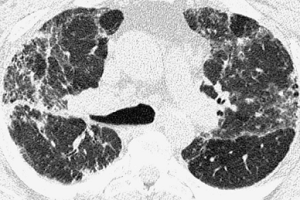
FIGURE 1 ■ Non-specific interstitial pneumonia secondary to bleomycin. The dominant abnormality is ground-glass opacification in association with a fine reticular pattern. The pattern of fibrosis most closely resembles non-specific interstitial pneumonia.
责任编辑:admin
上一篇:没有了
下一篇:医学文章阅读——Churg–Strauss Syndrome

微信公众号搜索“译员”关注我们,每天为您推送翻译理论和技巧,外语学习及翻译招聘信息。