Resulting from a genetic abnormality having autosomal recessive transmission, dyskinetic cilia syndrome is characterised by abnormal ciliary structure and function, leading to a reduced mucociliary clearance and chronic airway infection. Bronchiectasis and sinusitis are common manifestations. About half of patients have also a situs inversus. The combination of bronchiectasis, sinusitis and situs inversus is termed Kartagener's syndrome (Fig. 1). Men and women are equally affected, but in men the syndrome may be associated with immotile spermatozoa and infertility. Respiratory symptoms can generally be traced back to childhood. Bronchiectasis develops in childhood and adolescence and is associated with recurrent pneumonia. Both radiographs and CT typically show bilateral bronchiectasis with a basal (lower or middle lobe) predominance. Similar to that seen in patients with other causes of post-infectious bronchiolitis, cylindrical bronchiectasis is commonest and a diffuse bronchiolitis may be present.
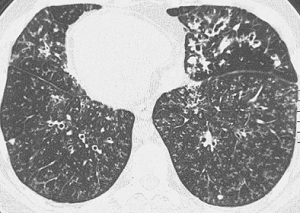
FIGURE 1 ■ Dyskinetic cilia syndrome. Axial CT at the level of the lower part of the chest. Bilateral bronchiectasis in the right middle lobe and the left lower lobe with some mucoid impactions. Note the presence of bronchial wall thickening and multiple foci of 'tree-in-bud' sign, reflecting infectious bronchiolitis. This patient also has situs inversus (Kartagener's syndrome).
责任编辑:admin
上一篇:没有了
下一篇:医学文章阅读——Accuracy of CT

微信公众号搜索“译员”关注我们,每天为您推送翻译理论和技巧,外语学习及翻译招聘信息。