Tumours at the lung apex (Pancoast's tumours, superior sulcus tumours) may resemble apical pleural thickening; however, the majority of peripheral lung cancers are approximately spherical or oval in shape. Lobulation, a sign that indicates uneven growth rates in different parts of the tumour, is common. Occasionally, a dumb-bell shape is encountered or two nodules are seen next to one another.
The term 'corona radiata' is used to describe numerous fine strands radiating into the lung from a central mass, sometimes with transradiant lung parenchyma between these strands. While not specific, this sign is highly suggestive of bronchial carcinoma (Fig. 1).
Absolutely spherical, sharply defined, smooth-edged nodules due to carcinoma of the lung are rare. A peripheral line shadow or 'tail' may be seen between a peripherally located mass lesion and the pleura, a phenomenon that occurs in both benign and malignant lesions. When associated with carcinoma of the lung, the 'tail' probably represents either plate-like atelectasis secondary to bronchial obstruction beyond the mass or septal oedema due to lymphatic obstruction.
Although the edges of a tumour are frequently well defined, some peripheral cancers, notably some types of adenocarcinoma, have ill-defined edges similar to pneumonia (Fig. 2).
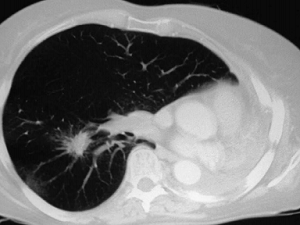
FIGURE 1 ■ CT demonstrating a second primary bronchogenic carcinoma in the right lung. The patient had undergone a previous left pneumonectomy 7 years earlier. The new tumour has spiculated edges, infiltrating into the adjacent lung (corona radiata).
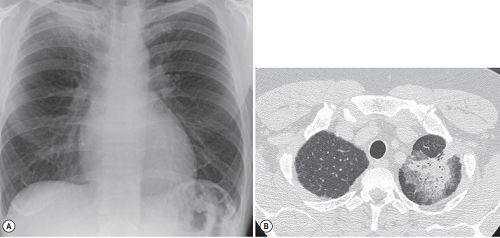
FIGURE 2 ■ Lung cancer mimicking pneumonia. (A) Squamous cell carcinoma resembling pneumonia. The entire opacity seen in the right upper zone on this radiograph is due to the carcinoma itself. (B) Apical adenocarcinoma of the left upper lobe of a different patient with ground-glass attenuation margins and an air bronchogram.
责任编辑:admin
上一篇:没有了
下一篇:医学文章阅读——The Current Standards of CT Technology for Lung Cancer

微信公众号搜索“译员”关注我们,每天为您推送翻译理论和技巧,外语学习及翻译招聘信息。