Below the medulla, the CNS extends into the elongated spinal cord, encased within the bony vertebral column and terminating at the first or second lumbar vertebra. The cord provides a series of segmental relays with the periphery, serving as a conduit for information flow to and from the brain. The motor and sensory nerve pathways relay neural signals that enter and exit the cord through posterior and anterior nerve roots and the spinal and peripheral nerves.
The spinal cord is divided into segments: cervical, from C1 to C8; thoracic, from T1 to T12; lumbar, from L1 to L5; sacral, from S1 to S5; and coccygeal (Fig. 1). The spinal cord is thickest in the cervical segment, which contains nerve tracts to and from both the upper and lower extremities.
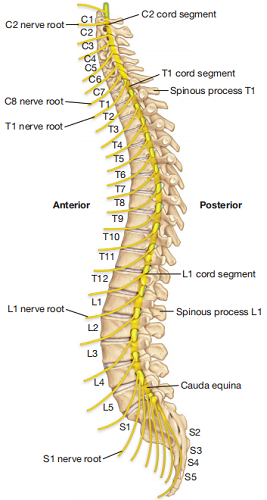
FIGURE 1. Spinal cord, lateral view.
Note that the spinal cord is not as long as the vertebral canal. The lumbar and sacral roots travel the longest intraspinal distance and fan out like a horse's tail at L1–L2, giving rise to the term cauda equina. To avoid injury to the spinal cord, most lumbar punctures are performed at the L3–L4 or L4–L5 vertebral interspaces.
责任编辑:admin
上一篇:没有了
下一篇:医学文章阅读——The Brain

微信公众号搜索“译员”关注我们,每天为您推送翻译理论和技巧,外语学习及翻译招聘信息。